
2048 Classic
Change direction
Game Details
- Technology: HTML5
- Playable on: Browser
- Genre: Sliding Puzzle
- Developer: Gabriele Cirulli
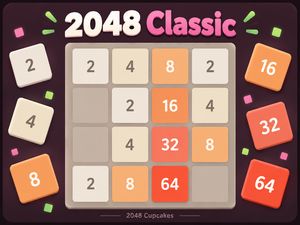
2048 Classic turns every arrow press into a board-wide puzzle. Tiles slide together, matching values combine, and one careless move can ruin a carefully built corner. The rules look simple, but each turn changes several rows or columns at once.
This single-player sliding puzzle runs directly in the browser through HTML5. You guide numbered tiles across a compact board, build larger values, and track your score as the position develops. There is no separate character or map to manage. Your choices happen entirely through tile movement.
Start to play 2048 Classic online now, then focus on the next useful merge rather than chasing every open space. Small decisions matter. A good run keeps room for new numbers while protecting future combinations.
The 2048 Classic playing field uses a rigid four-by-four layout. That gives you sixteen individual slots for every number on the board. Each turn takes place inside this fixed space, so the available room never expands as your values grow.
At the start, the board contains tiles with small numbers, such as 2 or 4. Empty slots matter just as much as occupied ones. They give loose tiles somewhere to travel and leave room for new numbers after successful moves. Watch the gaps before choosing a direction.
A four-by-four board creates constant pressure. Large tiles need space around them, while smaller pairs need routes toward one another. A move that improves one row may leave another row crowded. Check the whole arrangement before pressing an arrow, not just the tile you want to combine.
Think in rows and columns rather than isolated squares. Every slot belongs to both a horizontal and vertical path. This structure lets one move shift several values at once. It also means a promising pair can become harder to reach after another line changes.
The board rewards planning, not random movement. Keep track of open slots, matching values, and the direction of possible travel. When the grid starts filling, each square becomes valuable. Protecting that space gives you more choices on later turns.
Each directional command moves all loose tiles in that direction. A tile travels until it reaches the edge or meets another tile. You cannot steer one block while leaving the rest untouched.
This global movement makes every arrow a board decision. A left move affects every row, while an up move affects every column. One useful shift can create a new opening, but it can also change positions elsewhere. Study the full grid before committing.
Two identical tiles merge when they meet during a move. The game removes that pair and creates one tile with double its value. Two 2s become 4. Two 4s become 8. The same arithmetic continues through higher values.
This rule gives every small tile a possible role. A 2 may join another 2, then later contribute to an 8 or 16. Watch for pairs that sit in the same movement line. A matching value does not help if another tile blocks the route.
Order matters when several equal tiles share one row or column. A single move can combine one pair, then leave the new value beside another matching tile. You should read the line from the direction of travel. That helps you predict which values meet first.
Do not treat every immediate merge as progress. A new larger tile may occupy a useful empty slot. It may also break the shape you planned to preserve. Choose merges that keep nearby values arranged for later combinations.
Two 1024 tiles create the 2048 tile. That target comes from the same doubling rule as every earlier combination. Build toward it through controlled pairs, while avoiding moves that scatter your largest values across the board.
After a move creates a slide or merge, a fresh tile appears in an empty square. The incoming value typically shows 2, although 4 can also spawn periodically. Every successful turn therefore changes the puzzle twice: your move shifts the board, then the new number adds pressure.
Keep open squares available whenever possible. A full board leaves no place for another tile, and only matching neighbors can save the run. Empty space gives your next arrow more room to work.
Tiles slide as far as the chosen direction allows. Matching values may combine during that movement.
Pause before each command. First, identify the tiles that could merge. Next, check which spaces will open or close. Then choose the arrow that improves the wider position. This quick review prevents many accidental shifts.
Use horizontal arrows to organize rows and vertical arrows to organize columns. A pair only helps when both tiles can reach the same line. If another block sits between them, the move may stop without producing a merge.
Arrow presses also reshape areas you were not watching. A move aimed at one pair may push a high tile toward an edge. It may fill a gap needed by smaller values. Look at every row and column before acting.
Save open space for future turns. When several arrows seem possible, prefer the direction that leaves more empty slots. That choice keeps new spawns from sealing the board too soon.
Do not press arrows simply to keep moving. A slide only helps when it supports a later merge or creates useful room. If a direction changes nothing, it does not advance the board. If it changes everything, understand the result first.
Strong control comes from prediction. Imagine the tiles after the slide, then imagine the new number appearing afterward. You cannot control that incoming value, but you can control how much room remains for it.
Try 2048 Classic right here and test each arrow with a clear plan.
The primary victory arrives when two 1024 tiles combine. Their collision creates the 2048 tile, marking the main goal of the run. Every earlier merge prepares the values needed for that final pairing.
Reaching this target requires more than collecting large numbers. You must keep matching values accessible and preserve enough empty space for fresh spawns. A high tile trapped behind unrelated blocks may contribute little.
Build steadily. Let smaller pairs grow before the board becomes crowded. Keep your strongest values arranged so future moves can bring matching numbers together. The final merge depends on many earlier choices.
Many versions let you continue after reaching 2048. That gives you a chance to raise the score and create larger values. The central milestone remains the same: combine the two 1024 tiles successfully.
The run ends when all sixteen slots contain tiles and no adjacent tiles share an identical value. Without an empty square or a legal matching pair, no arrow can improve the board.
At that point, movement stops producing progress. The grid has reached saturation, and the game records a loss state. Protect open space before the final slots disappear.
Gabriele Cirulli created the original 2048 game in 2014. The release built its identity around a clear idea: slide numbered tiles across a four-by-four grid and merge matching values.
Players could focus on the board without learning a large control system. The arrow keys changed direction, while the doubling rule explained the puzzle’s progress.
That compact design helped define 2048 Classic. The game combines simple inputs with increasingly difficult decisions. Each new turn adds pressure, yet the core objective stays easy to understand.
The original browser edition remains a single-player sliding puzzle built around its grid, arrow-key controls, and doubling merges.
Its straightforward structure also made the game easy to recognize across later adaptations. The classic experience still centers on moving tiles and building the target value.
| Game | Why Similar |
|---|---|
| 2048 Merge Blocks | Shares the core mechanic of combining matching power-of-two number tiles to form higher-value numbered tiles toward reaching 2048. |
| Drop & Merge the Numbers | Shares the core mechanic of merging identical power-of-two numbers to double their value and create higher-numbered tiles. |
| 2048 X2 Legend | Shares the objective of merging identical numbered blocks to create higher powers of two and increase the score. |
Examine the positions of the starting two tiles, which will show values of 2 or 4 placed randomly on the 4x4 grid.
Keep open spaces available across the sixteen tiles as a new 2 or 4 appears in an empty slot after every valid slide.
Continue merging numbers systematically to construct 128, 256, 512, and 1024 tiles until you can join two 1024 blocks into the 2048 victory tile.
Browser keyboard: Arrow Keys — change direction.
2048 Classic opens in a phone browser, but it is played with the keyboard, so a computer works best.
No. 2048 Classic runs in your browser on this page, with nothing to download or install.
The original game was created by developer Gabriele Cirulli and released as an open web browser game in 2014. It established the standard rules of sliding number tiles across a 4x4 grid.
If all sixteen grid slots fill with tiles and no adjacent blocks have identical numbers, no valid moves can be made. The game officially ends in a loss, prompting you to start a new game.
Helpful Resources:
2048 Classic is a focused sliding puzzle for singleplayer play in a browser. Developed by Gabriele Cirulli and built with HTML5, it delivers a clean, accessible experience without unnecessary complexity. Its compact format makes it easy to start, while thoughtful decisions keep each session engaging.
Use the Arrow Keys to change direction and interact with the puzzle. The controls are simple to learn, letting you focus on the experience itself. The browser format makes it easy to begin a focused singleplayer session. If you enjoy browser puzzles that reward concentration and patience, 2048 Classic is a great choice. Play 2048 Classic right here on this page.
No comments yet. Be the first to share your thoughts!